Networks & Connectomes
Part of the running example, where stage 5 adds a connectome and a coupling function.
A whole-brain model is dynamics on a network. Three things have to be decided: where the connectome comes from, how regions couple, and whether every region and connection behaves the same way.
The first decision is usually the quickest. TVB-O ships curated connectomes you can reference by IRI, so most experiments never build one. You build your own when the parcellation, the cohort or the tractography method has to match something specific.
Getting a network
How activity travels
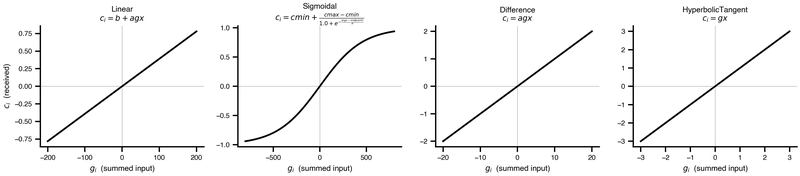
Coupling is where most first experiments go wrong, in two specific ways: the coupling key must be the model’s own input port rather than a name you invent, and a raw connectome carries streamline counts in the hundreds of thousands, which will drive any model to NaN unless it is normalized. Both are covered on that page.
When regions differ
Giving regions their own parameters.
Heterogeneous edgesGiving connections their own behaviour.
Hierarchical & surface networksA fine mesh layered onto a coarse parent network.
For a region with genuine internal structure rather than different parameters, see Beyond the mean field.