flowchart LR
    subgraph TVB["TVB Simulator"]
        Sim[Simulator]
        Conn[Connectivity]
        Mod[Model]
        Surf[CorticalSurface]
        RM[RegionMapping]
    end

    subgraph TVBO["TVBO"]
        Exp[SimulationExperiment]
        Net[Network]
        Dyn[Dynamics]
    end

    Sim -->|from_tvb_simulator| Exp
    Conn -->|from_tvb| Net
    Surf -->|from_tvb_surface| Net
    RM -->|from_tvb_surface| Net

    Exp -->|execute / run| Sim
    Net -->|"execute(format='tvb')"| Conn
    Dyn -->|"execute(format='tvb')"| Mod

    style TVB fill:none,stroke:#555
    style TVBO fill:none,stroke:#555
The Virtual Brain (TVB)
Bidirectional interoperability with TVB simulator and data types
TVBO provides full bidirectional integration with The Virtual Brain (TVB). You can import TVB objects into tvbo, modify or persist them, and export back to TVB — or use TVB as a simulation backend directly.
Integration Overview
| Direction | Method | Input | Output |
|---|---|---|---|
| TVB → tvbo | Network.from_tvb(conn) |
Connectivity |
Network |
| TVB → tvbo | Network.from_tvb_zip(path) |
ZIP file | Network |
| TVB → tvbo | Network.from_tvb_surface(conn, surf, rmap) |
Conn + Surface + RegionMapping | (Network, Network) |
| TVB → tvbo | SimulationExperiment.from_tvb_simulator(sim) |
Simulator |
SimulationExperiment |
| tvbo → TVB | net.execute(format="tvb") |
Network |
Connectivity |
| tvbo → TVB | dyn.execute(format="tvb") |
Dynamics |
Model |
| tvbo → TVB | exp.execute(format="tvb") |
SimulationExperiment |
Simulator |
| tvbo → TVB | exp.run(format="tvb") |
SimulationExperiment |
TimeSeries |
Pages
| Page | Description |
|---|---|
| Connectome Round-Trip | Lossless connectivity import/export with HDF5 persistence and surface meshes |
Quick Examples
Import a TVB Simulator
Convert a fully configured TVB Simulator into a tvbo SimulationExperiment — preserving the model, coupling, integrator, monitors, noise, and network:
import numpy as np
from tvbo import Dynamics, SimulationExperiment, Network

# Build a TVB simulator the usual way
from tvb.simulator.lab import *

conn = connectivity.Connectivity.from_file()
conn.configure()
conn.speed = np.array([3.0])

sim = simulator.Simulator(
    model=models.JansenRit(),
    coupling=coupling.SigmoidalJansenRit(
        a=np.array([1.0]),
        cmax=np.array([0.005]),
        midpoint=np.array([6.0]),
        r=np.array([0.56]),
    ),
    integrator=integrators.HeunStochastic(
        dt=0.1,
        noise=noise.Additive(nsig=np.array([0.01])),
    ),
    connectivity=conn,
    monitors=[monitors.Raw(), monitors.TemporalAverage(period=1.0)],
    simulation_length=1000.0,
)
sim.configure()

print(f"TVB Simulator: {sim.model.__class__.__name__}, "
      f"{conn.weights.shape[0]} regions, dt={sim.integrator.dt}")
2026-08-27 13:01:01,103 - WARNING - tvb.basic.readers - File 'hemispheres' not found in ZIP.
TVB Simulator: JansenRit, 76 regions, dt=0.1exp = SimulationExperiment.from_tvb_simulator(sim)
print(f"Model: {exp.model}")
print(f"Coupling: {list(exp.network.coupling)}")
print(f"Integrator: {exp.integration.method}")
print(f"Duration: {exp.integration.duration} ms")
print(f"dt: {exp.integration.step_size}")
print(f"Noise: {'additive' if exp.integration.noise.additive else 'multiplicative'}")
print(f"Monitors: {list(exp.observations.keys())}")Model: JansenRit
Coupling: ['SigmoidalJansenRit']
Integrator: Heun
Duration: 1000.0 ms
dt: 0.1
Noise: additive
Monitors: ['Raw', 'TemporalAverage']The imported experiment is a standard tvbo object — you can inspect the YAML representation, modify parameters, or re-export:
# Show the YAML specification
print(exp.to_yaml()[:1500])
print("...")
id: 21826435288162472764931109575780387236
model: JansenRit
part: main
dynamics:
name: JansenRit
parameters:
A:
name: A
value: !!float 'np.float64(3.25)'
B:
name: B
value: !!float 'np.float64(22.0)'
a:
name: a
value: !!float 'np.float64(0.1)'
b:
name: b
value: !!float 'np.float64(0.05)'
v0:
name: v0
value: !!float 'np.float64(5.52)'
nu_max:
name: nu_max
value: !!float 'np.float64(0.0025)'
r:
name: r
value: !!float 'np.float64(0.56)'
J:
name: J
value: !!float 'np.float64(135.0)'
a_1:
name: a_1
value: !!float 'np.float64(1.0)'
a_2:
name: a_2
value: !!float 'np.float64(0.8)'
a_3:
name: a_3
value: !!float 'np.float64(0.25)'
a_4:
name: a_4
value: !!float 'np.float64(0.25)'
p_min:
name: p_min
value: !!float 'np.float64(0.12)'
p_max:
name: p_max
value: !!float 'np.float64(0.32)'
mu:
name: mu
value: !!float 'np.float64(0.22)'
state_variables:
y0:
name: y0
domain:
enforce: none
lo: -1.0
hi: 1.0
log_scale: false
record: true
variable_of_interest: true
coupling_variable: false
equation_type: differential
equation_order: 1
y1:
name: y1
domain:
enforce: none
lo: -500.0
hi: 500.0
log_scale: false
record: true
var
...Export a Dynamics Model to TVB
Any tvbo Dynamics can be compiled into a TVB-compatible Model object. This uses Mako code generation to produce a TVB Model subclass:
dyn = Dynamics.from_db("JansenRit")
tvb_model = dyn.execute(format="tvb")

print(f"TVB Model:  {tvb_model.__class__.__name__}")
print(f"State vars: {tvb_model.state_variables}")
print(f"Parameters: {tvb_model.parameter_names}")
TVB Model: JansenRit
State vars: ['y0', 'y1', 'y2', 'y3', 'y4', 'y5']
Parameters: ['A', 'B', 'J', 'a_1', 'a_2', 'a_3', 'a_4', 'a', 'b', 'mu', 'nu_max', 'r', 'v0']You can inspect the generated TVB model code:
code = dyn.render_code(format="tvb")
# Show first 40 lines
for line in code.splitlines()[:40]:
    print(line)
print("...")
# Auto-generated standalone model file
import numpy as np
import scipy.special
from tvb.basic.neotraits.api import Attr, Final, List, NArray, Range
from tvb.simulator.models.base import Model
class JansenRit(Model):
A = NArray(
label=r":math:`A`",
default=np.array([3.25]),
domain=Range(lo=2.6, hi=9.75, step=0.05),
doc="""Maximum amplitude of EPSP [mV]""",
)
B = NArray(
label=r":math:`B`",
default=np.array([22.0]),
domain=Range(lo=17.6, hi=110.0, step=0.2),
doc="""Maximum amplitude of IPSP [mV]""",
)
J = NArray(
label=r":math:`J`",
default=np.array([135.0]),
domain=Range(lo=65.0, hi=1350.0, step=1.0),
doc="""Average number of synapses between three neuronal populations of the model""",
)
a_1 = NArray(
label=r":math:`a_1`",
default=np.array([1.0]),
domain=Range(lo=0.5, hi=1.5, step=0.1),
doc="""Average probability constant of the number of synapses made by the pyramidal cells to the dendrites of the excitatory interneurons (feedback excitatory loop)""",
)
a_2 = NArray(
label=r":math:`a_2`",
default=np.array([0.8]),
domain=Range(lo=0.4, hi=1.2, step=0.1),
doc="""Average probability constant of the number of synapses made by the EINs to the dendrites of the PCs""",
)
a_3 = NArray(
...Define and Run a Simulation
A SimulationExperiment can also be defined from a YAML string — useful for sharing reproducible experiment specifications:
# Define an experiment from YAML
exp2 = SimulationExperiment.from_string("""
label: Quick JansenRit demo

model:
  name: JansenRit

network:
  coupling:
    SigmoidalJansenRit:
      parameters:
        a: {value: 1.0}
        cmax: {value: 0.005}
        midpoint: {value: 6.0}
        r: {value: 0.56}

integration:
  method: HeunStochastic
  duration: 500
  step_size: 0.1
  noise:
    additive: true
    parameters:
      sigma: {value: 0.01}

observations:
  Raw:
    name: Raw
""")
# Coupling belongs to the network, so carry the declared one onto the imported connectivity
_declared_coupling = exp2.network.coupling
exp2.network = Network.from_tvb(conn)
exp2.network.coupling = _declared_coupling

print(f"Model:    {exp2.model}")
print(f"Method:   {exp2.integration.method}")
print(f"Duration: {exp2.integration.duration} ms")
print(f"Step:     {exp2.integration.step_size}")
Model: JsonObj(name='JansenRit')
Method: HeunStochastic
Duration: 500.0 ms
Step: 0.1Run a simulation using the TVB simulator we already built:
# Run using the previously configured TVB simulator
results = sim.run(simulation_length=500)
(raw_time, raw_data), (tavg_time, tavg_data) = results

import matplotlib.pyplot as plt

fig, axes = plt.subplots(2, 1, figsize=(10, 5), sharex=True)

t = raw_time / 1000  # ms → s

# Plot PSP (y0 - y1) — typical JR output
axes[0].plot(t, raw_data[:, 1, :, 0] - raw_data[:, 2, :, 0],
             alpha=0.3, linewidth=0.5)
axes[0].set_ylabel("PSP (y₀ − y₁)")
axes[0].set_title("Jansen-Rit EEG proxy across 76 regions")

# Plot y0 (excitatory PSP)
axes[1].plot(t, raw_data[:, 0, :, 0], alpha=0.3, linewidth=0.5)
axes[1].set_ylabel("y₀")
axes[1].set_xlabel("Time (s)")

plt.tight_layout()
plt.show()
/Users/leonmartin_bih/tools/tvbo/.venv/lib/python3.12/site-packages/numba/np/ufunc/gufunc.py:263: RuntimeWarning: overflow encountered in _numba_dfun_jr
return self.ufunc(*args, **kwargs)
/Users/leonmartin_bih/tools/tvbo/.venv/lib/python3.12/site-packages/tvb/simulator/coupling.py:372: RuntimeWarning: overflow encountered in exp
(self.cmax - self.cmin) / (1.0 + numpy.exp(self.r * (self.midpoint - (x_j[:, 0] - x_j[:, 1]))))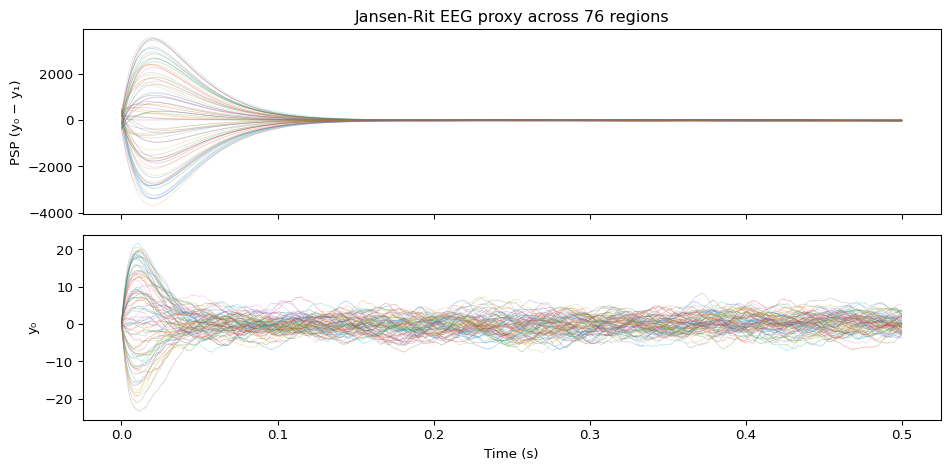
Import a Connectivity
For connectome-only workflows, import TVB connectivity without a full simulator. See the Connectome Round-Trip page for the complete walkthrough including surface meshes and HDF5 persistence.
from tvb.datatypes.connectivity import Connectivity

conn = Connectivity.from_file()
conn.configure()

net = Network.from_tvb(conn)
print(f"{net.number_of_nodes} regions, "
      f"weights: [{net.weights_matrix.min():.3f}, {net.weights_matrix.max():.3f}]")
2026-08-27 13:01:03,093 - WARNING - tvb.basic.readers - File 'hemispheres' not found in ZIP.
76 regions, weights: [0.000, 3.000]/var/folders/ym/9kw1g21j1nd7kwfn8c0z3st40000gn/T/ipykernel_88735/444856751.py:8: DeprecationWarning: Network.weights_matrix is deprecated; use Network.matrix("weight") instead.
f"weights: [{net.weights_matrix.min():.3f}, {net.weights_matrix.max():.3f}]")net.plot_matrix()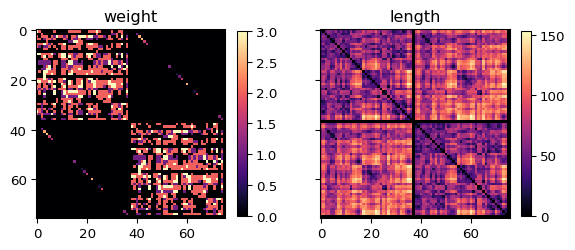
The round-trip is lossless:
import numpy as np

conn2 = net.execute(format="tvb")
np.testing.assert_allclose(conn2.weights, conn.weights)
np.testing.assert_allclose(conn2.tract_lengths, conn.tract_lengths)
print("✓ Weights identical")
print("✓ Tract lengths identical")
✓ Weights identical
✓ Tract lengths identical