Dynamics Database Gallery

Overview of all models in the TVBO database, organised by category.

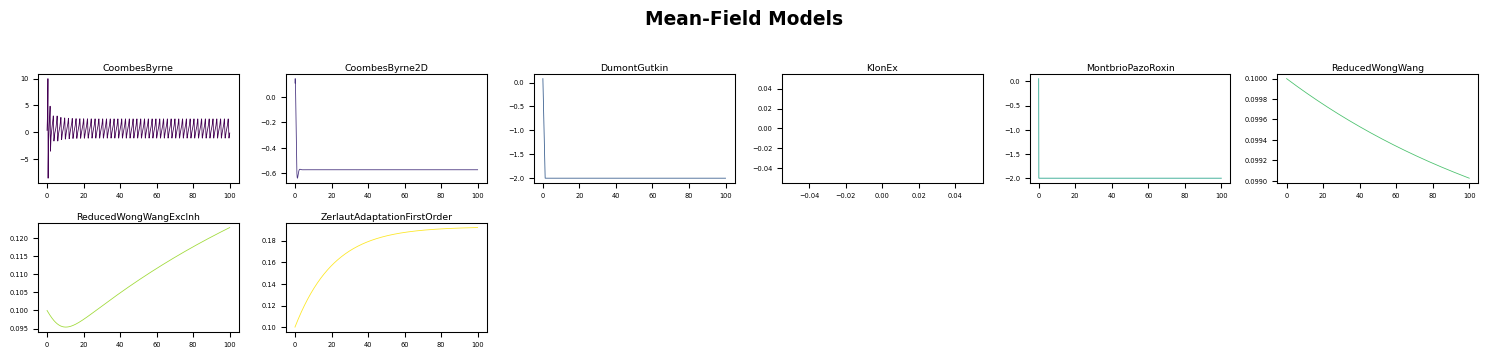
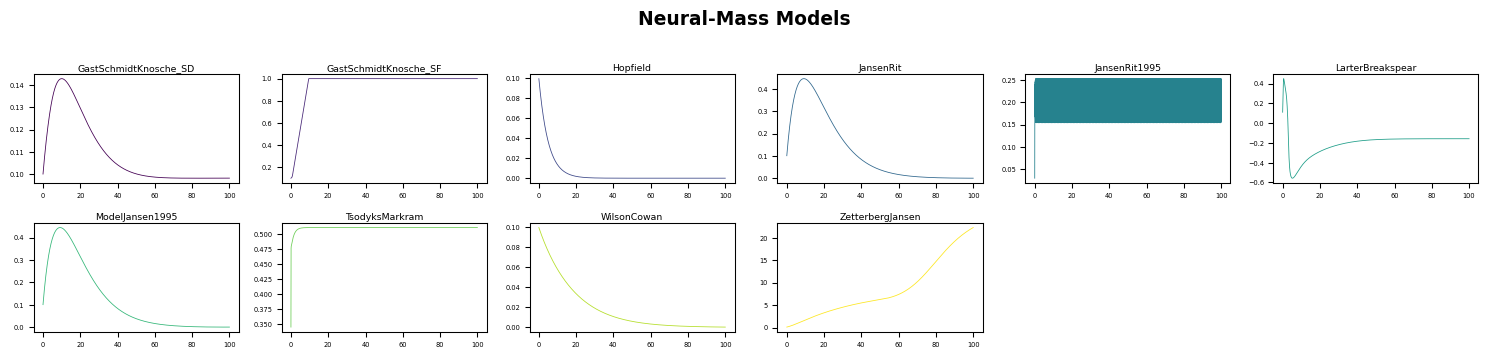
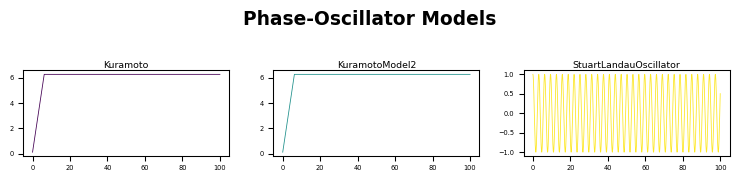
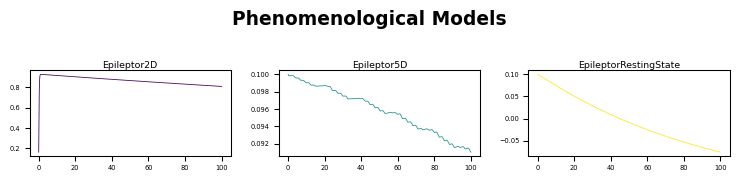
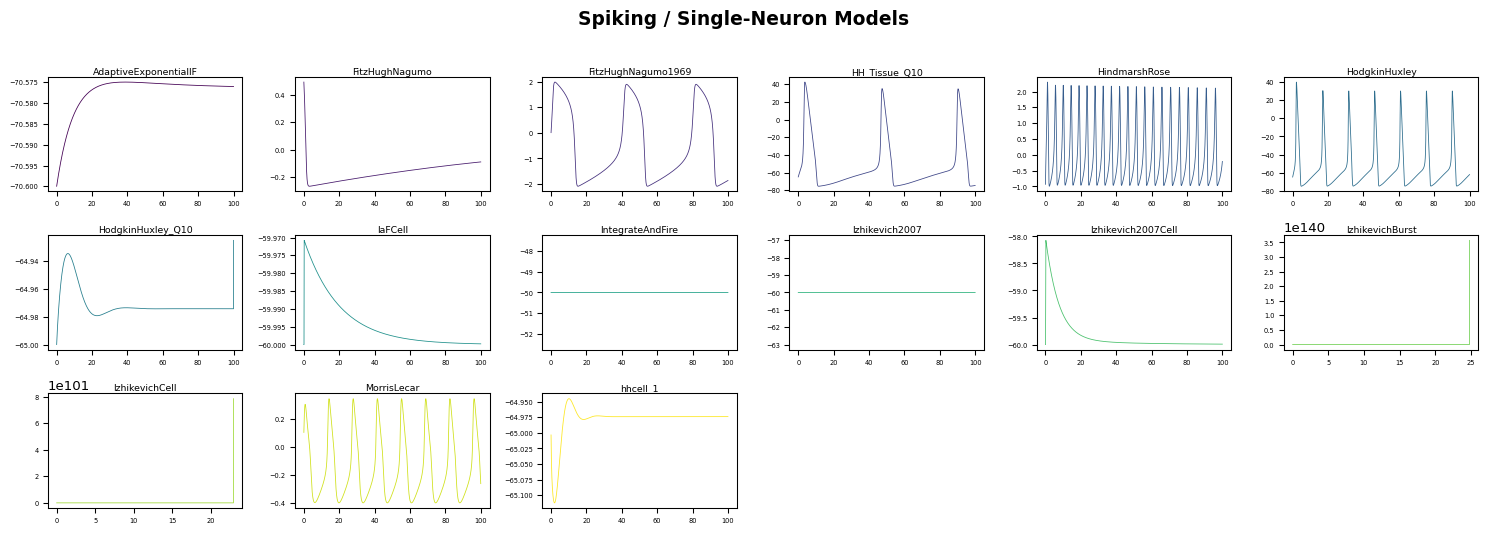
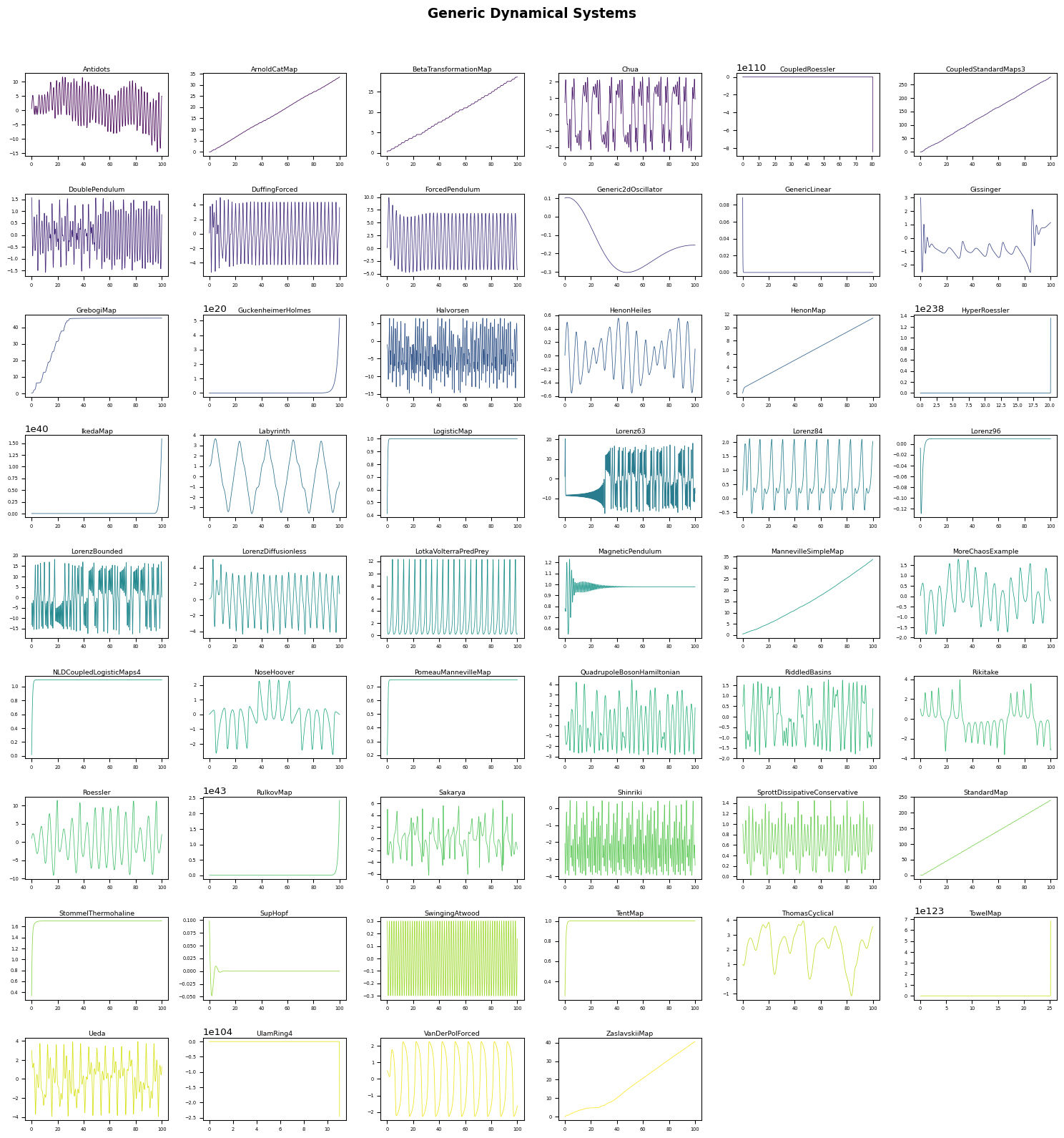
Models from the TVBO database simulated for 100 ms and plotted by category. Each panel shows the first state variable; colours are sampled from the viridis colourmap.

Models that fail to integrate are skipped rather than reported as failures, so the gallery below is not necessarily complete. The summary table at the end gives the honest tally: Available models per category versus how many actually Plotted.

Code
import warnings, logging
warnings.filterwarnings("ignore")
logging.disable(logging.WARNING)

import numpy as np
import matplotlib.pyplot as plt
from matplotlib.colors import Normalize
from matplotlib.cm import ScalarMappable
from tvbo import Dynamics, SimulationExperiment
Code
DURATION = 100.0          # ms
CATEGORIES = [
    ("mean_field",        "Mean-Field Models"),
    ("neural_mass",       "Neural-Mass Models"),
    ("phase_oscillator",  "Phase-Oscillator Models"),
    ("phenomenological",  "Phenomenological Models"),
    ("spiking",           "Spiking / Single-Neuron Models"),
    ("generic",           "Generic Dynamical Systems"),
]

results = {}   # model_type -> [(name, data_array)]
for cat, _ in CATEGORIES:
    results[cat] = []
    for name in Dynamics.list_db(model_type=cat):
        try:
            d = Dynamics.from_db(name)
            exp = SimulationExperiment(dynamics=d)
            exp.integration.duration = DURATION
            r = exp.run()
            da = r.integration.data
            results[cat].append((name, da))
        except Exception:
            pass  # skip models that fail to run
Code
cmap = plt.get_cmap("viridis")

for cat, title in CATEGORIES:
    items = results[cat]
    if not items:
        continue
    n = len(items)
    ncols = min(6, n)
    nrows = int(np.ceil(n / ncols))
    fig, axes = plt.subplots(
        nrows, ncols,
        figsize=(ncols * 2.6, nrows * 1.8),
        squeeze=False,
    )
    fig.suptitle(title, fontsize=14, fontweight="bold", y=1.02)
    colors = [cmap(i / max(n - 1, 1)) for i in range(n)]

    for idx, (name, da) in enumerate(items):
        ax = axes[idx // ncols, idx % ncols]
        y = da.isel(variable=0).values
        t = da.coords["time"].values
        ax.plot(t, y, color=colors[idx], linewidth=0.6)
        ax.set_title(name, fontsize=7, pad=2)
        ax.tick_params(labelsize=5)
        ax.set_xlabel("")
        ax.set_ylabel("")

    # hide unused axes
    for idx in range(n, nrows * ncols):
        axes[idx // ncols, idx % ncols].set_visible(False)

    fig.tight_layout()
    plt.show()

Summary

Code
import pandas as pd
rows = []
for cat, title in CATEGORIES:
    attempted = len(Dynamics.list_db(model_type=cat))
    succeeded = len(results[cat])
    rows.append({"Category": title, "Available": attempted, "Plotted": succeeded})
pd.DataFrame(rows)
Table 1
Category Available Plotted
0 Mean-Field Models 11 11
1 Neural-Mass Models 19 19
2 Phase-Oscillator Models 3 3
3 Phenomenological Models 3 3
4 Spiking / Single-Neuron Models 17 16
5 Generic Dynamical Systems 53 53