Fitting, inference & optimization
Simulating a model is one thing; making it match data is another. This part of the specification covers three related but distinct jobs, and choosing between them is the first decision.
Fitting minimises a loss against a measurement, and gives you one parameter set. Tuning drives the model to a target regime with an algorithm rather than a loss, which is what FIC and E/I balance do. Inference estimates a distribution over parameters rather than a point, and tells you how well-determined each one actually is.
These workflows run on the tvboptim JAX backend, which is JIT-compiled, differentiable and GPU-capable. If you arrived wanting to know how TVB-O relates to tvboptim as a tool rather than as a backend, see coming from tvboptim.
What you declare
Worked examples
Each of these is a complete study rather than a snippet, and they live in Examples & Use-Cases:
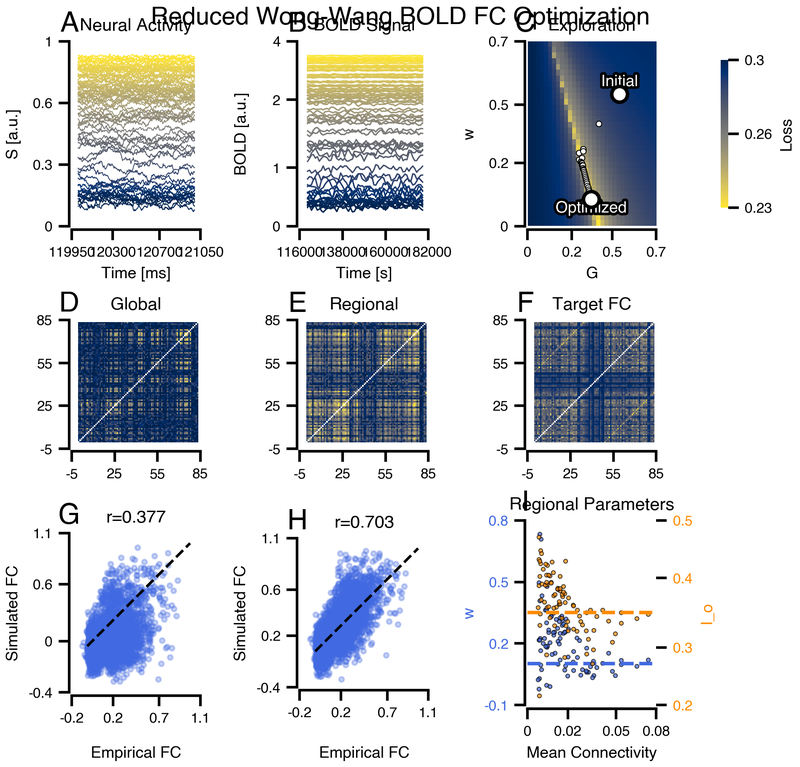 Reduced Wong-Wang
Match empirical BOLD functional connectivity
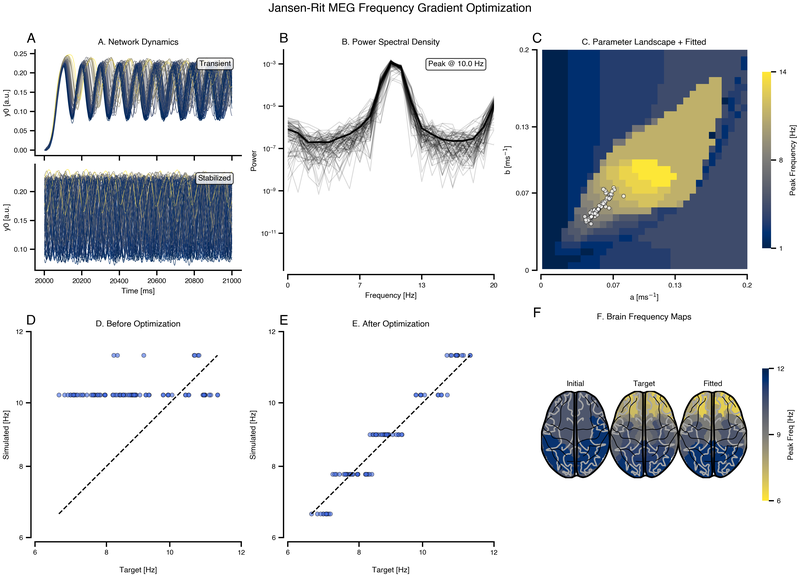 Jansen-Rit
Match a MEG frequency gradient
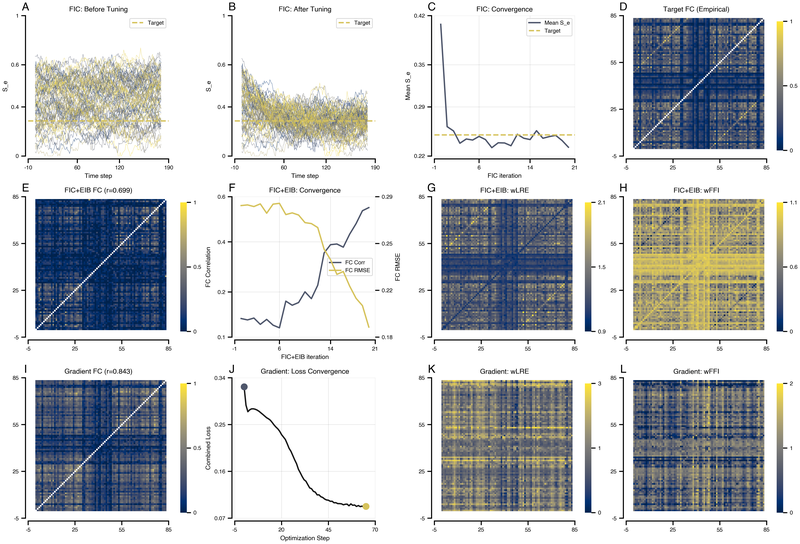 E/I tuning
Drive regions to a target firing rate
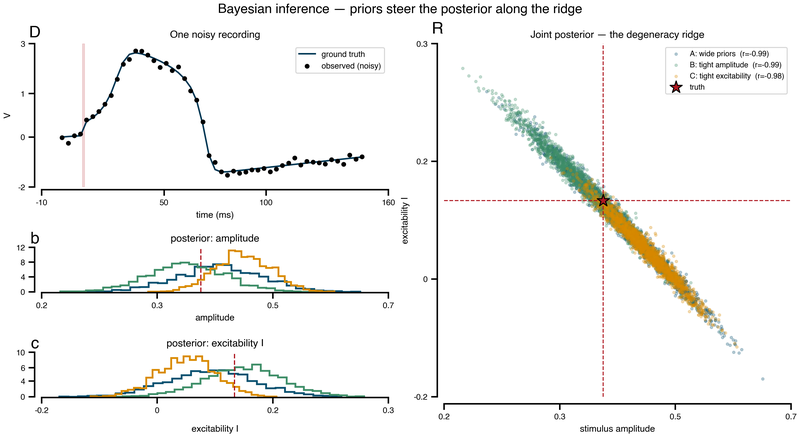 Bayesian inference
Estimate posteriors over parameters
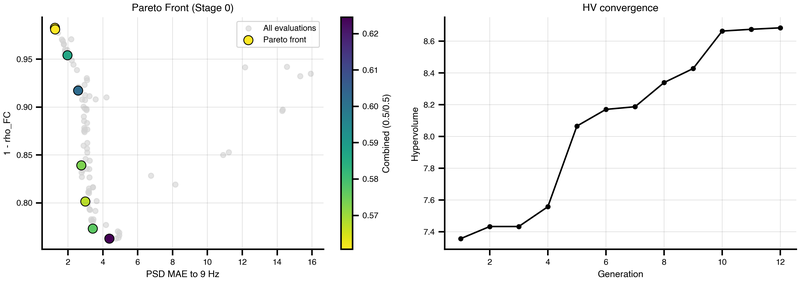 Multi-objective Hopf-Pareto
Trade off competing objectives
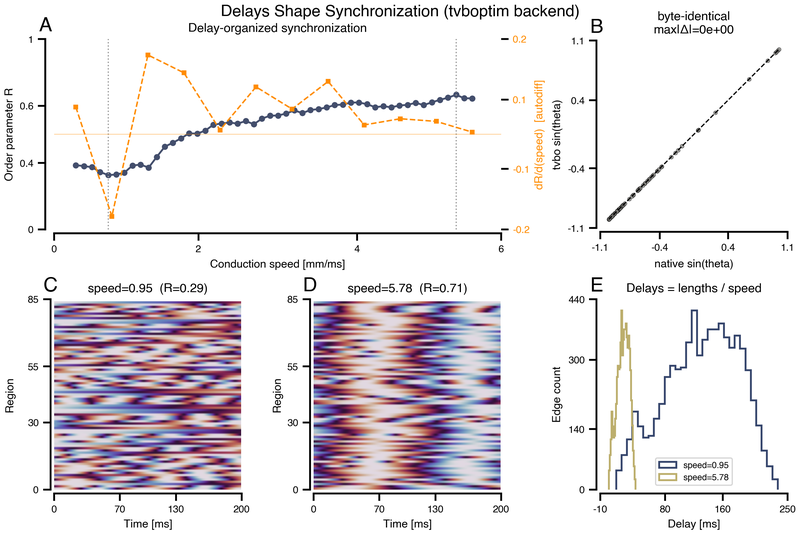 Delay & speed synchronization
Fit conduction speed and delays
Before you trust a fit
A converged optimiser is not the same as a good answer. Gradient stability & truncated BPTT explains why gradients through long chaotic trajectories explode and what truncation buys you. A fitted parameter set that sits on the edge of its search range has almost certainly been truncated rather than found, and Bifurcation & continuation tells you which dynamical regime the answer landed in.