from tvbo import Dynamics

# Slow Hopf oscillator - the DRIVER (~0.05 Hz period)
# Large amplitude, slow oscillation to clearly modulate other nodes
driver = Dynamics.from_string("""
name: SlowDriver
parameters:
  a:
    value: 0.5
  omega:
    value: 0.3
state_variables:
  x:
    equation:
      rhs: "a*x - omega*z - x*(x**2 + z**2) + c_in"
    initial_value: 1.0
  z:
    equation:
      rhs: "omega*x + a*z - z*(x**2 + z**2)"
    initial_value: 0.0
coupling_inputs:
  c_in: {}
""")

# FitzHugh-Nagumo in EXCITABLE regime
# Will fire bursts when driven by positive input from driver
fhn = Dynamics.from_string("""
name: Excitable
parameters:
  a:
    value: 0.7
  b:
    value: 0.8
  tau:
    value: 12.5
  I_ext:
    value: 0.3
state_variables:
  v:
    equation:
      rhs: "v - v**3/3 - w + I_ext + c_in"
    initial_value: -1.0
  w:
    equation:
      rhs: "(v + a - b*w)/tau"
    initial_value: -0.5
coupling_inputs:
  c_in: {}
""")

# Van der Pol as relaxation oscillator
# Receives INHIBITORY input - active when driver is LOW
vdp = Dynamics.from_string("""
name: Relaxation
parameters:
  mu:
    value: 2.0
state_variables:
  x:
    equation:
      rhs: "mu*(x - x**3/3 - w) + c_in"
    initial_value: -1.5
  w:
    equation:
      rhs: "x/mu"
    initial_value: 0.0
coupling_inputs:
  c_in: {}
""")Network topology:
- Driver (node 0) sends POSITIVE coupling to Excitable (node 1)
- Driver (node 0) sends NEGATIVE coupling to Relaxation (node 2)
- This creates anti-phase modulation: when driver is UP, node 1 is excited, node 2 is suppressed
import yaml
from tvbo import SimulationExperiment
from tvbo import Network

network_yaml = """
label: HeterogeneousModulation
number_of_nodes: 3
nodes:
  - id: 0
    label: Driver
    dynamics: SlowDriver
  - id: 1
    label: Excitable
    dynamics: Excitable
  - id: 2
    label: Relaxation
    dynamics: Relaxation
edges:
  - source: 0
    target: 1
    parameters:
      weight:
        value: 0.8
    source_var: x_out
    target_var: c_in
  - source: 0
    target: 2
    parameters:
      weight:
        value: -0.6
    source_var: x_out
    target_var: c_in
  - source: 1
    target: 2
    parameters:
      weight:
        value: 0.1
    source_var: v_out
    target_var: c_in
  - source: 2
    target: 1
    parameters:
      weight:
        value: 0.1
    source_var: x_out
    target_var: c_in
"""

# Parse network from YAML
network = Network(**yaml.safe_load(network_yaml))
network.plot_graph(
edge_cmap="coolwarm", edge_kwargs={"width": 5}, node_size=10)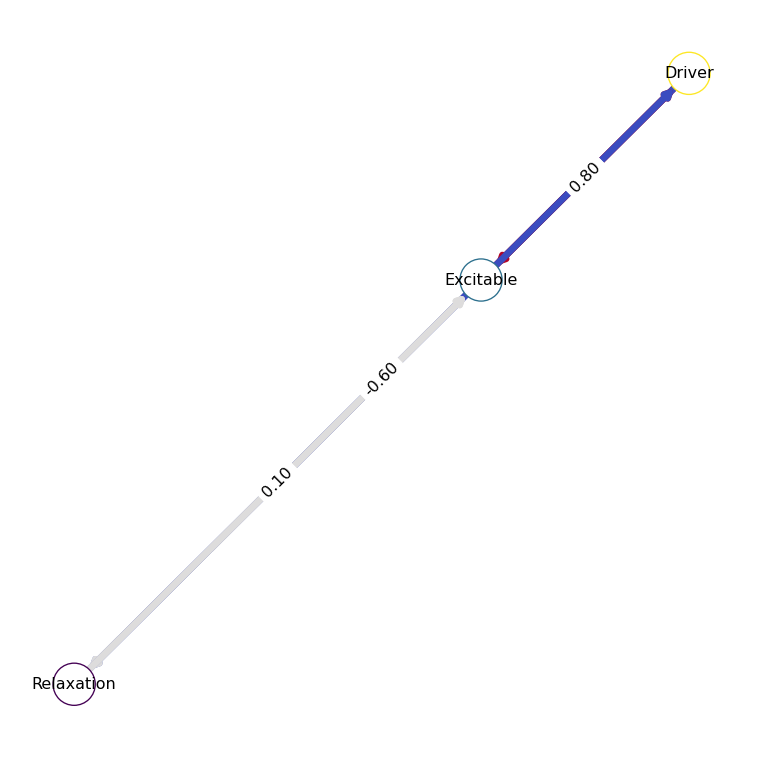
network.dynamics["SlowDriver"] = driver
network.dynamics["Excitable"] = fhn
network.dynamics["Relaxation"] = vdp

# Create experiment with dynamics library and network
exp = SimulationExperiment(
    network=network,
)
res = exp.run("pyrates")
Compilation Progress
--------------------
(1) Translating the circuit template into a networkx graph representation...
...finished.
(2) Preprocessing edge transmission operations...
...finished.
(3) Parsing the model equations into a compute graph...
...finished.
Model compilation was finished.
Simulation Progress
-------------------
(1) Generating the network run function...
(2) Processing output variables...
...finished.
(3) Running the simulation...
...finished after 1.2947301669992157s.import matplotlib.pyplot as plt
import numpy as np
fig, axes = plt.subplots(3, 1, figsize=(12, 8), sharex=True)
t_tvbo = res.time
# Plot Driver (slow oscillation)
ax = axes[0]
# Overlay TVBO data with dashed line
driver_tvbo = res.get_region("Driver").get_state_variable("x")
ax.plot(
t_tvbo,
driver_tvbo.data.squeeze(),
)
ax.set_ylabel("Driver\n(Hopf)")
# Plot Excitable
ax = axes[1]
excitable_tvbo = res.get_region("Excitable").get_state_variable("v")
ax.plot(
t_tvbo,
excitable_tvbo.data.squeeze(),
)
ax.set_ylabel("Excitable\n(FHN)")
# Plot Relaxation
ax = axes[2]
relaxation_tvbo = res.get_region("Relaxation").get_state_variable("x")
ax.plot(
t_tvbo,
relaxation_tvbo.data.squeeze(),
lw=1.5,
alpha=0.7,
label="TVBO TimeSeries",
)
ax.set_ylabel("Relaxation\n(VdP)")
ax.set_xlabel("Time (ms)")
plt.show()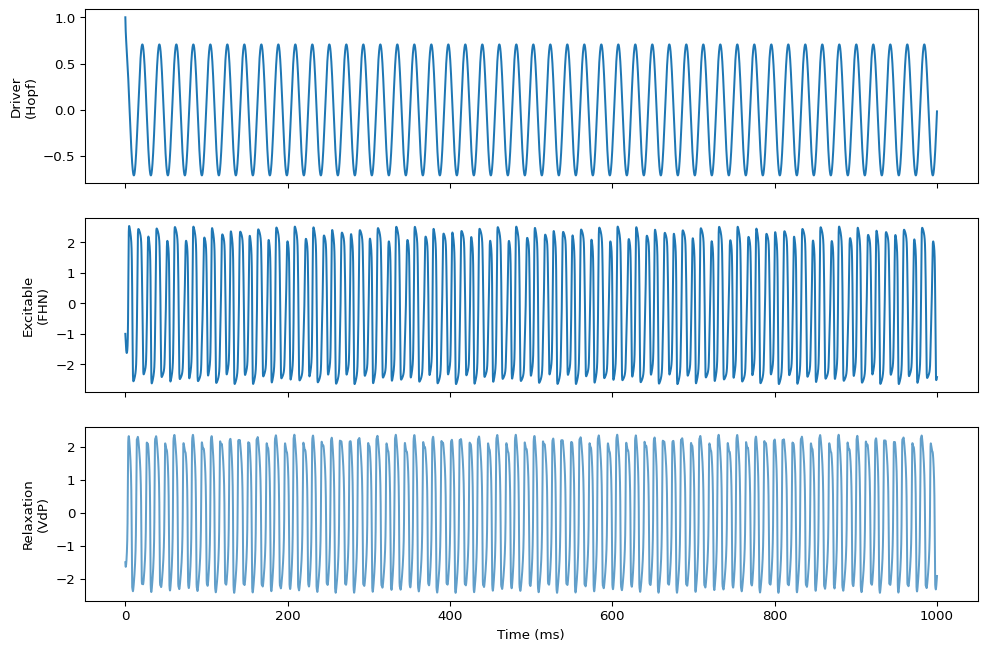
Tip
To set per-node initial states (not just parameters), see Initial Conditions & Initial State. Node-level state: blocks let you set different starting values of each state variable per node, with optional random sampling via distributions.