Interoperability · NeuroML / LEMS
Model: iafTauCell
The simplest NeuroML2 example: a leaky integrate-and-fire neuron with a single state variable \(v\) , governed by:
\[\frac{dv}{dt} = \frac{E_L - v}{\tau}\]
With spike event: if \(v > \text{thresh}\) , then \(v \leftarrow \text{reset}\) .
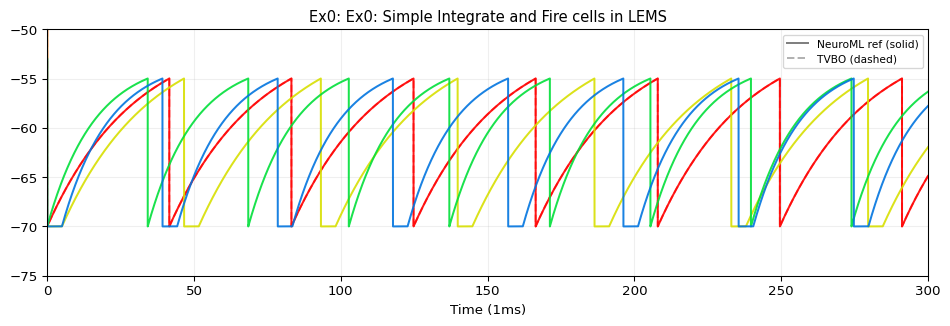
Parameters: leakReversal=-50 mV, thresh=-55 mV, reset=-70 mV, tau=30 ms.
Note: since leakReversal > thresh, this cell will never fire. The NeuroML example also includes iafTauRefCell, iafCell, and iafRefCell variants. The TVBO version matches the iafTauCell (tau-based, no refractory period).
1. Define in TVBO
from tvbo import SimulationExperiment= SimulationExperiment.from_string(""" label: "NeuroML Ex0: Integrate-and-Fire (iafTau)" dynamics: name: IntegrateAndFire parameters: leakReversal: { value: -50.0, unit: mV } tau: { value: 30.0, unit: ms } thresh: { value: -55.0, unit: mV } reset: { value: -70.0, unit: mV } state_variables: v: equation: { rhs: "(leakReversal - v) / tau" } initial_value: -50.0 unit: mV variable_of_interest: true events: spike: condition: { rhs: "v > thresh" } affect: { rhs: "v = reset" } network: number_of_nodes: 1 integration: method: euler step_size: 0.005 duration: 300.0 time_scale: ms """ )print (f"Model: { exp. dynamics. name if exp. dynamics else 'network' } " )print (f"State variables: { list (exp.dynamics.state_variables.keys())} " )print (f"Events: { list (exp.dynamics.events.keys())} " )
Model: IntegrateAndFire
State variables: ['v']
Events: ['spike']
2. Render LEMS XML
= exp.render("lems" )print (xml[:2000 ])
<Lems>

  <!-- Tell jLEMS/jNeuroML which component is the simulation entry point. -->
  <Target component="sim_NeuroML_Ex0__Integrate_and_Fire__iafTau_"/>

  <Include file="Cells.xml"/>
  <Include file="Networks.xml"/>
  <Include file="Simulation.xml"/>

  <!-- ════════════════════════════════════════════════════════════════
       Dynamics ComponentType & Component instances
       ════════════════════════════════════════════════════════════════ -->

  <!-- ════════════════════════════════════════════════════════════════
       ComponentType: IntegrateAndFire
       Generated from TVBO Dynamics: IntegrateAndFire
       ════════════════════════════════════════════════════════════════ -->
  <ComponentType name="IntegrateAndFire">

    <!-- Parameters -->
    <Parameter name="leakReversal" dimension="voltage"/>
    <Parameter name="reset" dimension="voltage"/>
    <Parameter name="tau" dimension="time"/>
    <Parameter name="thresh" dimension="voltage"/>
    <!-- Coupling inputs -->
    <!-- Initial condition parameters -->
    <Parameter name="v_0" dimension="voltage"/>

    <!-- Time conversion for derivatives.
         When all parameters and state variables carry proper LEMS dimensions,
         LEMS handles unit conversion natively (e.g. tau="30 ms" → 0.03 s).
         No SEC constant is needed and TimeDerivatives use the RHS directly.
         When dimensions are "none" (dimensionless models), / SEC converts
         from model time to SI seconds.
         all_dimensioned=True  needs_sec=False  time_scale=ms -->

    <!-- Exposures (one per state variable) -->
    <Exposure name="v" dimension="voltage"/>

    <Dynamics>

      <!-- State variables -->
      <StateVariable name="v" dimension="voltage" exposure="v"/>

      <!-- Derived variables (simple and conditional/piecewise) -->

      <!-- ── Flat dynamics (no spike events) ── -->

      <!-- Time derivatives -->
      <TimeDerivative variable="v" value="(leakReversal - v)/tau"/>

      <!-- Initial conditi
3. Run Reference (NeuroML2 via jNeuroML)
from tvbo.adapters.neuroml import run_lems_example, LEMS_EXAMPLES= run_lems_example("LEMS_NML2_Ex0_IaF.xml" )print (f"Reference output files: { list (ref_outputs.keys())} " )for name, arr in ref_outputs.items():print (f" { name} : shape= { arr. shape} " )
Reference output files: ['iaf_v.dat']
  iaf_v.dat: shape=(60001, 5)
4. Run TVBO Version
= exp.run("neuroml" )= result.integration.dataprint (f"TVBO: { da. dims} , shape= { da. shape} " )
pyNeuroML >>> 16:38:49 - INFO - Loading LEMS file: tvbo_lems_sim.xml and running with jNeuroML
pyNeuroML >>> 16:38:49 - INFO - Executing: (java -Xmx400M  -Djava.awt.headless=true -jar  "/Users/leonmartin_bih/tools/tvbo/.venv/lib/python3.12/site-packages/pyneuroml/utils/./../lib/jNeuroML-0.14.0-jar-with-dependencies.jar"  tvbo_lems_sim.xml  -nogui -I '') in directory: /var/folders/ym/9kw1g21j1nd7kwfn8c0z3st40000gn/T/tmpci_axmq9
pyNeuroML >>> 16:38:50 - INFO - Command completed successfully!
TVBO: ('time', 'variable'), shape=(60001, 1)
5. Compare & Plot
from tvbo.adapters.neuroml import plot_lems_comparison"LEMS_NML2_Ex0_IaF.xml" , ref_outputs, result.integration.data, title_prefix= "Ex0" )