<Lems>

  <!-- Tell jLEMS/jNeuroML which component is the simulation entry point. -->
  <Target component="sim_NeuroML_Ex9__FitzHugh_Nagumo"/>

  <Include file="Cells.xml"/>
  <Include file="Networks.xml"/>
  <Include file="Simulation.xml"/>

  <!-- ════════════════════════════════════════════════════════════════
       Dynamics ComponentType & Component instances
       ════════════════════════════════════════════════════════════════ -->

  <!-- ════════════════════════════════════════════════════════════════
       ComponentType: FitzHughNagumo
       Generated from TVBO Dynamics: FitzHughNagumo
       ════════════════════════════════════════════════════════════════ -->
  <ComponentType name="FitzHughNagumo">

    <!-- Parameters -->
    <Parameter name="I" dimension="none"/>
    <!-- Coupling inputs -->
    <!-- Initial condition parameters -->
    <Parameter name="V_0" dimension="none"/>
    <Parameter name="W_0" dimension="none"/>

    <!-- Time conversion for derivatives.
         When all parameters and state variables carry proper LEMS dimensions,
         LEMS handles unit conversion natively (e.g. tau="30 ms" → 0.03 s).
         No SEC constant is needed and TimeDerivatives use the RHS directly.
         When dimensions are "none" (dimensionless models), / SEC converts
         from model time to SI seconds.
         all_dimensioned=False  needs_sec=False  time_scale=s -->
    <Constant name="SEC" dimension="time" value="1s"/>

    <!-- Exposures (one per state vari
3. Run Reference
from tvbo.adapters.neuroml import run_lems_exampleref_outputs = run_lems_example("LEMS_NML2_Ex9_FN.xml")for name, arr in ref_outputs.items():print(f" {name}: shape={arr.shape}")
ex9.dat: shape=(20001, 3)
4. Run TVBO
result = exp.run("neuroml")da = result.integration.dataprint(f"TVBO: {da.dims}, shape={da.shape}")
pyNeuroML >>> 13:07:51 - INFO - Loading LEMS file: tvbo_lems_sim.xml and running with jNeuroML
pyNeuroML >>> 13:07:51 - INFO - Executing: (java -Xmx400M  -Djava.awt.headless=true -jar  "/Users/leonmartin_bih/tools/tvbo/.venv/lib/python3.12/site-packages/pyneuroml/utils/./../lib/jNeuroML-0.14.0-jar-with-dependencies.jar"  tvbo_lems_sim.xml  -nogui -I '') in directory: /var/folders/ym/9kw1g21j1nd7kwfn8c0z3st40000gn/T/tmp0j4gh4td
pyNeuroML >>> 13:07:52 - INFO - Command completed successfully!
TVBO: ('time', 'variable'), shape=(20001, 2)
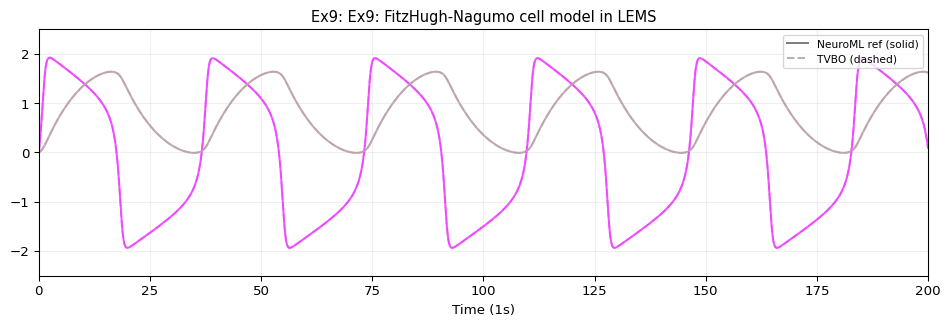
5. Compare & Plot
from tvbo.adapters.neuroml import plot_lems_comparisonplot_lems_comparison("LEMS_NML2_Ex9_FN.xml", ref_outputs, result.integration.data, title_prefix="Ex9")