Interoperability · NeuroML / LEMS
Model: Fractional Conductance
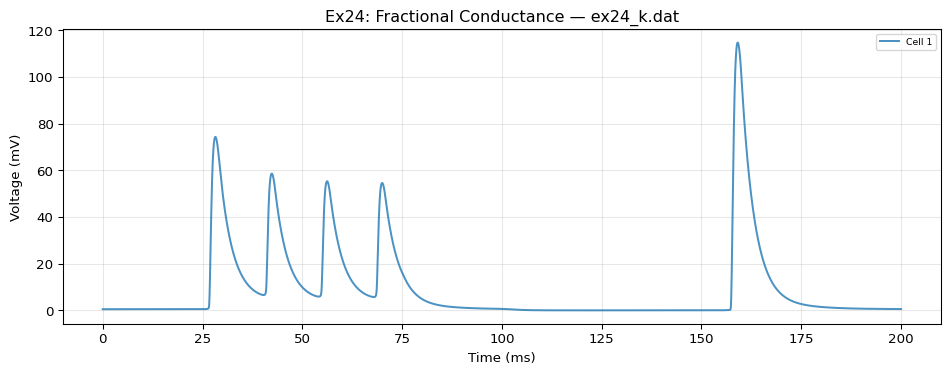
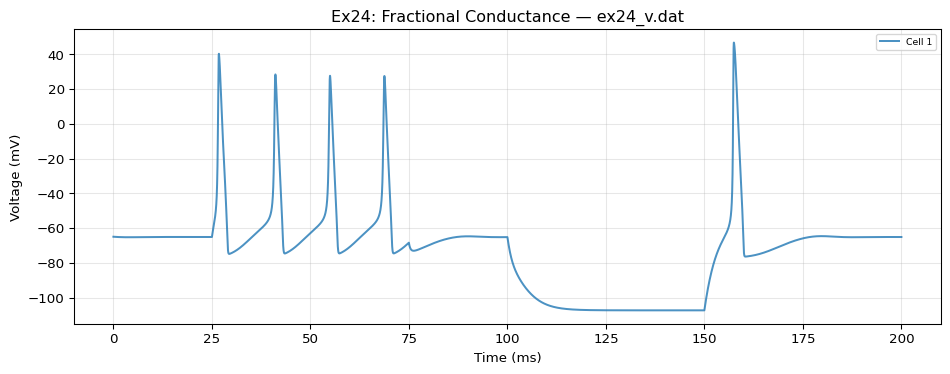
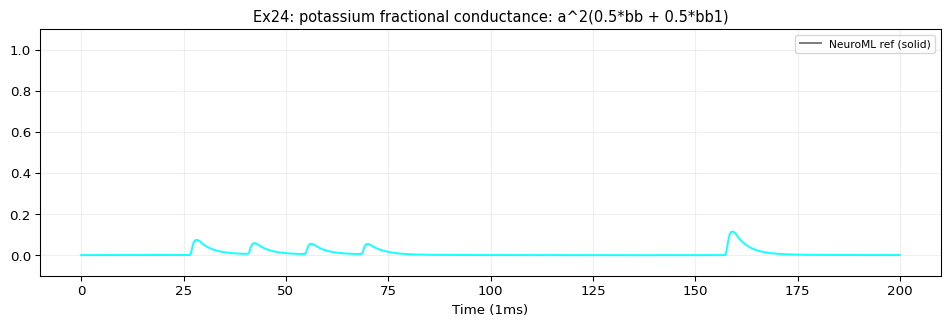
Demonstrates <gateFractional> with <subGate> — the slow potassium channel uses a fractional conductance formalism where gate b is composed of two sub-gates (bb, bb1), each contributing 50 % of the total conductance with independent time courses.
The channel also includes:
Custom rate types (kslow_a_alpha_rate, kslow_a_beta_rate) — built from equations
Custom time course types (kslow_b_tau, kslow_b1_tau) — built from equations
Q10 temperature scaling at 34 °C (experimentalTemp = 21 °C)
cell type with single-segment cylinder morphology and channelDensity
TVBO defines all of this declaratively using the composition tree (components: key). Standard NeuroML types use iri: neuroml:* shortcuts; custom types use derived_variables: to build LEMS <ComponentType> definitions from equations.
1. Define in TVBO
from tvbo import SimulationExperiment= SimulationExperiment.from_string(""" label: "NeuroML Ex24: Fractional Conductance" dynamics: name: hhtest iri: neuroml:cell parameters: diameter: { value: 10 } length: { value: 20 } specificCapacitance: { value: 1.0, unit: uF_per_cm2 } initMembPotential: { value: -65.0, unit: mV } spikeThresh: { value: 0, unit: mV } resistivity: { value: 0.1, unit: kohm_cm } network_temperature: { value: 34, unit: degC } components: # ── Slow K channel with fractional conductance ── k_slow: name: k_slow iri: neuroml:ionChannelHH parameters: conductance: { value: 10, unit: pS } species: { description: k } condDensity: { value: 0.036, unit: S_per_cm2 } erev: { value: -77, unit: mV } ion: { description: k } components: a: name: a iri: neuroml:gateHHrates parameters: instances: { value: 2 } components: q10Settings: name: q10Settings iri: neuroml:q10ExpTemp parameters: q10Factor: { value: 2.3 } experimentalTemp: { value: 21, unit: degC } forwardRate: name: forwardRate iri: neuroml:kslow_a_alpha_rate parameters: a0: { value: 0.0052 } a1: { value: 11.1 } a2: { value: 13.1 } a3: { value: 0.01938 } a4: { value: -1.27 } a5: { value: 71 } a6: { value: -0.0053 } derived_variables: V: { equation: { rhs: "v / VOLT_SCALE" } } r: { equation: { rhs: "(a0*(V-a1)/(1-exp(-(V-a1)/a2))) / TIME_SCALE" } } reverseRate: name: reverseRate iri: neuroml:kslow_a_beta_rate parameters: a0: { value: 0.0052 } a1: { value: 11.1 } a2: { value: 13.1 } a3: { value: 0.01938 } a4: { value: -1.27 } a5: { value: 71 } a6: { value: -0.0053 } derived_variables: V: { equation: { rhs: "v / VOLT_SCALE" } } r: { equation: { rhs: "(a3*exp(-(V-a4)/a5)+a6) / TIME_SCALE" } } b: name: b iri: neuroml:gateFractional parameters: instances: { value: 1 } components: bb: name: bb iri: neuroml:subGate parameters: fractionalConductance: { value: 0.5 } components: steadyState: name: steadyState iri: neuroml:HHSigmoidVariable parameters: rate: { value: 1 } midpoint: { value: -58, unit: mV } scale: { value: -11, unit: mV } timeCourse: name: timeCourse iri: neuroml:kslow_b_tau parameters: v05b: { value: -58 } b0: { value: 360 } b11: { value: 1010 } b2: { value: -75 } b3: { value: 48 } b4: { value: 23.7 } b5: { value: -54 } derived_variables: V: { equation: { rhs: "v / VOLT_SCALE" } } t: { equation: { rhs: "(b0+(b11+b4*(V-b5))*exp(-(V-b2)*(V-b2)/(b3*b3))) * TIME_SCALE" } } bb1: name: bb1 iri: neuroml:subGate parameters: fractionalConductance: { value: 0.5 } components: steadyState: name: steadyState iri: neuroml:HHSigmoidVariable parameters: rate: { value: 1 } midpoint: { value: -58, unit: mV } scale: { value: -11, unit: mV } timeCourse: name: timeCourse iri: neuroml:kslow_b1_tau parameters: bb0: { value: 2350 } bb1: { value: 1380 } bb2: { value: 0.01118 } bb3: { value: -210 } bb4: { value: 0.0306 } derived_variables: V: { equation: { rhs: "v / VOLT_SCALE" } } t: { equation: { rhs: "(bb0+bb1*exp(-bb2*V)+bb3*exp(-bb4*V)) * TIME_SCALE" } } # ── Standard K channel ── k: name: k iri: neuroml:ionChannelHH parameters: conductance: { value: 10, unit: pS } species: { description: k } condDensity: { value: 0.036, unit: S_per_cm2 } erev: { value: -77, unit: mV } ion: { description: k } components: n: name: n iri: neuroml:gateHHrates parameters: instances: { value: 4 } components: forwardRate: name: forwardRate iri: neuroml:HHExpLinearRate parameters: rate: { value: 0.1, unit: per_ms } midpoint: { value: -55, unit: mV } scale: { value: 10, unit: mV } reverseRate: name: reverseRate iri: neuroml:HHExpRate parameters: rate: { value: 0.125, unit: per_ms } midpoint: { value: -65, unit: mV } scale: { value: -80, unit: mV } # ── Leak channel ── leak: name: leak iri: neuroml:ionChannelPassive parameters: conductance: { value: 10, unit: pS } condDensity: { value: 0.0003, unit: S_per_cm2 } erev: { value: -54.3, unit: mV } ion: { description: non_specific } # ── Na channel ── na: name: na iri: neuroml:ionChannelHH parameters: conductance: { value: 10, unit: pS } species: { description: na } condDensity: { value: 0.12, unit: S_per_cm2 } erev: { value: 50, unit: mV } ion: { description: na } components: m: name: m iri: neuroml:gateHHrates parameters: instances: { value: 3 } components: forwardRate: name: forwardRate iri: neuroml:HHExpLinearRate parameters: rate: { value: 1, unit: per_ms } midpoint: { value: -40, unit: mV } scale: { value: 10, unit: mV } reverseRate: name: reverseRate iri: neuroml:HHExpRate parameters: rate: { value: 4, unit: per_ms } midpoint: { value: -65, unit: mV } scale: { value: -18, unit: mV } h: name: h iri: neuroml:gateHHrates parameters: instances: { value: 1 } components: forwardRate: name: forwardRate iri: neuroml:HHExpRate parameters: rate: { value: 0.07, unit: per_ms } midpoint: { value: -65, unit: mV } scale: { value: -20, unit: mV } reverseRate: name: reverseRate iri: neuroml:HHSigmoidRate parameters: rate: { value: 1, unit: per_ms } midpoint: { value: -35, unit: mV } scale: { value: 10, unit: mV } # ── Inputs ── IClamp1: name: IClamp1 iri: neuroml:pulseGenerator parameters: delay: { value: 25, unit: ms } duration: { value: 50, unit: ms } amplitude: { value: 0.1, unit: nA } IClamp2: name: IClamp2 iri: neuroml:pulseGenerator parameters: delay: { value: 100, unit: ms } duration: { value: 50, unit: ms } amplitude: { value: -0.1, unit: nA } integration: step_size: 0.01 duration: 200.0 time_scale: ms """ )print (f"Model: { exp. dynamics. name if exp. dynamics else 'network' } " )print (f"Components: { list (exp.dynamics.modes.keys())} " )
Model: hhtest
Components: ['IClamp1', 'IClamp2', 'k', 'k_slow', 'leak', 'na']
* Owlready2 * Warning: ignoring cyclic subclass of/subproperty of, involving:
  http://uri.interlex.org/tgbugs/uris/readable/atlas/Space
2. Render LEMS XML
= exp.render("lems" , use_standard_types= True )print (xml[:3000 ])
<Lems>
  <Target component="sim_NeuroML_Ex24__Fractional_Conductance"/>

  <Include file="Cells.xml"/>
  <Include file="Networks.xml"/>
  <Include file="Inputs.xml"/>
  <Include file="Simulation.xml"/>

    <ComponentType name="kslow_a_alpha_rate" extends="baseVoltageDepRate">
        <Constant name="TIME_SCALE" dimension="time" value="1 ms"/>
        <Constant name="VOLT_SCALE" dimension="voltage" value="1 mV"/>
        <Constant name="a0" dimension="none" value="0.0052"/>
        <Constant name="a1" dimension="none" value="11.1"/>
        <Constant name="a2" dimension="none" value="13.1"/>
        <Constant name="a3" dimension="none" value="0.01938"/>
        <Constant name="a4" dimension="none" value="-1.27"/>
        <Constant name="a5" dimension="none" value="71"/>
        <Constant name="a6" dimension="none" value="-0.0053"/>
        <Dynamics>
            <DerivedVariable name="V" dimension="none" value="v / VOLT_SCALE"/>
            <DerivedVariable name="r" exposure="r" dimension="per_time" value="(a0*(V-a1)/(1-exp(-(V-a1)/a2))) / TIME_SCALE"/>
        </Dynamics>
    </ComponentType>

    <ComponentType name="kslow_a_beta_rate" extends="baseVoltageDepRate">
        <Constant name="TIME_SCALE" dimension="time" value="1 ms"/>
        <Constant name="VOLT_SCALE" dimension="voltage" value="1 mV"/>
        <Constant name="a0" dimension="none" value="0.0052"/>
        <Constant name="a1" dimension="none" value="11.1"/>
        <Constant name="a2" dimension="none" value="13.1"/>
        <Constant name="a3" dimension="none" value="0.01938"/>
        <Constant name="a4" dimension="none" value="-1.27"/>
        <Constant name="a5" dimension="none" value="71"/>
        <Constant name="a6" dimension="none" value="-0.0053"/>
        <Dynamics>
            <DerivedVariable name="V" dimension="none" value="v / VOLT_SCALE"/>
            <DerivedVariable name="r" exposure="r" dimension="per_time" value="(a3*exp(-(V-a4)/a5)+a6) / TIME_SCALE"/>
        </Dynamics>
    </ComponentType>

    <ComponentType name="kslow_b_tau" extends="baseVoltageDepTime">
        <Constant name="TIME_SCALE" dimension="time" value="1 ms"/>
        <Constant name="VOLT_SCALE" dimension="voltage" value="1 mV"/>
        <Constant name="b0" dimension="none" value="360"/>
        <Constant name="b11" dimension="none" value="1010"/>
        <Constant name="b2" dimension="none" value="-75"/>
        <Constant name="b3" dimension="none" value="48"/>
        <Constant name="b4" dimension="none" value="23.7"/>
        <Constant name="b5" dimension="none" value="-54"/>
        <Constant name="v05b" dimension="none" value="-58"/>
        <Dynamics>
            <DerivedVariable name="V" dimension="none" value="v / VOLT_SCALE"/>
            <DerivedVariable name="t" exposure="t" dimension="time" value="(b0+(b11+b4*(V-b5))*exp(-(V-b2)*(V-b2)/(b3*b3))) * TIME_SCALE"/>
        </Dynamics>
    </ComponentType>

    <ComponentType name="kslow_b1_tau" extends="baseVoltageDepTime">
        <Const
3. Run Reference
from tvbo.adapters.neuroml import run_lems_example= run_lems_example("LEMS_NML2_Ex24_FractionalConductance.xml" )for name, arr in ref_outputs.items():print (f" { name} : shape= { arr. shape} " )
  ex24_k.dat: shape=(20001, 2)
  ex24_v.dat: shape=(20001, 2)
4. Run TVBO
= exp.run("neuroml" )= result.integration.dataprint (f"TVBO: { da. dims} , shape= { da. shape} " )
pyNeuroML >>> 13:06:20 - INFO - Loading LEMS file: tvbo_lems_sim.xml and running with jNeuroML
pyNeuroML >>> 13:06:20 - INFO - Executing: (java -Xmx400M  -Djava.awt.headless=true -jar  "/Users/leonmartin_bih/tools/tvbo/.venv/lib/python3.12/site-packages/pyneuroml/utils/./../lib/jNeuroML-0.14.0-jar-with-dependencies.jar"  tvbo_lems_sim.xml  -nogui -I '') in directory: /var/folders/ym/9kw1g21j1nd7kwfn8c0z3st40000gn/T/tmp1bocsiug
pyNeuroML >>> 13:06:21 - INFO - Command completed successfully!
TVBO: ('time', 'variable'), shape=(20001, 1)
5. Compare & Plot
from tvbo.adapters.neuroml import plot_lems_comparison"LEMS_NML2_Ex24_FractionalConductance.xml" , ref_outputs, result.integration.data, title_prefix= "Ex24" )