from tvbo import Dynamics, SimulationExperiment
from IPython.display import Markdown
lorenz = Dynamics(
parameters={
"sigma": {"value": 10.0},
"rho": {"value": 28.0},
"beta": {"value": 8 / 3},
},
state_variables={
"X": {"equation": {"rhs": "sigma * (Y - X)"}},
"Y": {"equation": {"rhs": "X * (rho - Z) - Y"}},
"Z": {"equation": {"rhs": "X * Y - beta * Z"}},
},
)
code = SimulationExperiment(dynamics=lorenz).render_code('jax')The Virtual Brain Ontology
Welcome to tvbo!
tvbo is a Python library for defining, simulating, and analyzing dynamical systems in computational neuroscience. It combines ontology-driven knowledge representation with flexible simulation capabilities.
Core Features:
- Load: Access curated models and studies from the knowledge database
- Specify: Define dynamical systems and network models with simple specification language
- Build: Configure brain network models
- Generate: Produce optimized simulation code (Python, JAX, Julia)
- Share: Export reproducible models with standardized metadata
Quickstart
pip install tvboFor more installation options, see the Installation Guide.
name: LorenzAttractor
parameters:
    sigma:
        value: 10
        label: Prandtl number
    rho:
        label: Rayleigh number
        value: 28
    beta:
        value: 2.6666666666666665
state_variables:
    X:
        equation:
        lhs: \dot{X}
        rhs: sigma * (Y - X)
    Y:
        equation:
        lhs: \dot{Y}
        rhs: X * (rho - Z) - Y
    Z:
        equation:
        lhs: \dot{Z}
rhs: X * Y - beta * Zoutput:
Markdown("```python" + code + "```")
import jax
from tvbo.data.types import TimeSeries
from tvbo.utils import Bunch
import jax.numpy as jnp


def cfun(weights, history, current_state, p, delay_indices, t):
    return jnp.zeros_like(current_state[0])


import jax.numpy as jnp
import jax.scipy as jsp


def dfun(current_state, t, cX, _p):
    # Parameters
    sigma = _p.sigma
    rho = _p.rho
    beta = _p.beta


    # State variables
    X = current_state[0]
    Y = current_state[1]
    Z = current_state[2]


    # Derivatives
    dX_dt = sigma*(Y - X)
    dY_dt = -Y + X*(rho - Z)
    dZ_dt = X*Y - Z*beta

    derivatives = jnp.array([dX_dt, dY_dt, dZ_dt])

    return derivatives


def integrate(state, weights, dt, params_integrate, delay_indices, external_input):
    """
    Heun Integration
    ================
    """
    t, _ = external_input
    noise = 0


    params_dfun, params_cfun, params_stimulus = params_integrate

    history, current_state = state
    stimulus = 0


    cX = jax.vmap(cfun, in_axes=(None, -1, -1, None, None, None), out_axes=-1)(weights, history, current_state, params_cfun, delay_indices, t)

    dX0 = dfun(current_state, t, cX, params_dfun)

    X = current_state


    # Calculate intermediate step X1
    X1 = X + dX0 * dt + noise + stimulus * dt

    # Calculate derivative X1
    dX1 = dfun(X1, t, cX, params_dfun)
    # Calculate the state change dX
    dX = (dX0 + dX1) * (dt / 2)
    next_state = current_state + (dX)


    return (history, next_state), next_state


import jax
import jax.numpy as jnp

def g(dt, nt, n_svar, n_nodes, n_modes, seed=0, sigma_vec=None, sigma=0.0, state=None):
    """Standard Gaussian white noise using xi ~ N(0,1).

    Returns (nt, n_svar, n_nodes, n_modes): sqrt(dt) * sigma * xi.

    - sigma_vec: optional per-state sigma (length n_svar).
    - sigma: scalar fallback when sigma_vec is None.
    - state: optional current state placeholder for future correlative noise.
    """
    key = jax.random.PRNGKey(int(seed))
    xi = jax.random.normal(key, (nt, n_svar, n_nodes, n_modes))

    if sigma_vec is not None:
        sigma_b = jnp.asarray(sigma_vec)[None, ..., None, None]
    else:
        sigma_b = jnp.asarray(sigma)

    noise = jnp.sqrt(dt) * sigma_b * xi
    return noise


def monitor_raw(time_steps, trace, params, t_offset = 0):
    dt = 0.01220703125
    return TimeSeries(time=(time_steps + t_offset) * dt, data=trace, title = "Raw")


def transform_parameters(_p):
    sigma, rho, beta = _p.sigma, _p.rho, _p.beta

    return _p

c_vars = jnp.array([]).astype(jnp.int32)

def kernel(state):
    # problem dimensions
    n_nodes = 1
    n_svar = 3
    n_cvar = 3
    n_modes = 1
    nh = 1

    current_state, history = (state.initial_conditions.data[-1], None) ## history = current_state

    ics = (history, current_state)
    weights = state.network.weights_matrix

    dn = jnp.arange(int(n_nodes)) * jnp.ones((int(n_nodes), int(n_nodes))).astype(jnp.int32)
    idelays = jnp.round(state.network.lengths_matrix / state.network.conduction_speed.value / state.dt).astype(jnp.int32) if state.network.conduction_speed.value > 0 else jnp.zeros((int(n_nodes), int(n_nodes)), dtype=jnp.int32)
    di = -1 * idelays - 1
    delay_indices = (di, dn)

    dt = state.dt
    nt = state.nt
    time_steps = jnp.arange(0, nt)

    # Generate batch noise using xi with per-state sigma_vec.
    # Prefer state-provided sigma_vec (supports vmapped sweeps); fallback to experiment-level constants.
    seed = getattr(state.noise, 'seed', 0) if hasattr(state.noise, 'seed') else 0
    try:
        sigma_vec_runtime = getattr(state.noise, 'sigma_vec', None)
    except Exception:
        sigma_vec_runtime = None
    sigma_vec = sigma_vec_runtime if sigma_vec_runtime is not None else jnp.array([0.,0.,0.])
    noise = g(dt, nt, n_svar, n_nodes, n_modes, seed=seed, sigma_vec=sigma_vec)


    p = transform_parameters(state.parameters.dynamics)
    params_integrate = (p, Bunch(), state.stimulus)

    op = lambda ics, external_input: integrate(ics, weights, dt, params_integrate, delay_indices, external_input)
    latest_carry, res = jax.lax.scan(op, ics, (time_steps, noise))

    trace = res


    trace = jnp.hstack((
        trace[:, [0], :],
        trace[:, [1], :],
        trace[:, [2], :],
        ))

    t_offset = 0
    time_steps = time_steps + 1


    labels_dimensions = {
        "Time": None,
        "State Variable": ['X', 'Y', 'Z'],
        "Space": ['0'],
        "Mode": ['m0'],
    }
    return TimeSeries(time=(time_steps + t_offset) * dt, data=trace, title = "Raw", sample_period=dt, labels_dimensions=labels_dimensions)
from tvbo import Dynamics, SimulationExperiment
lorenz = Dynamics(
parameters={
"sigma": {"value": 10.0},
"rho": {"value": 28.0},
"beta": {"value": 8 / 3},
},
state_variables={
"X": {"equation": {"rhs": "sigma * (Y - X)"}},
"Y": {"equation": {"rhs": "X * (rho - Z) - Y"}},
"Z": {"equation": {"rhs": "X * Y - beta * Z"}},
},
)
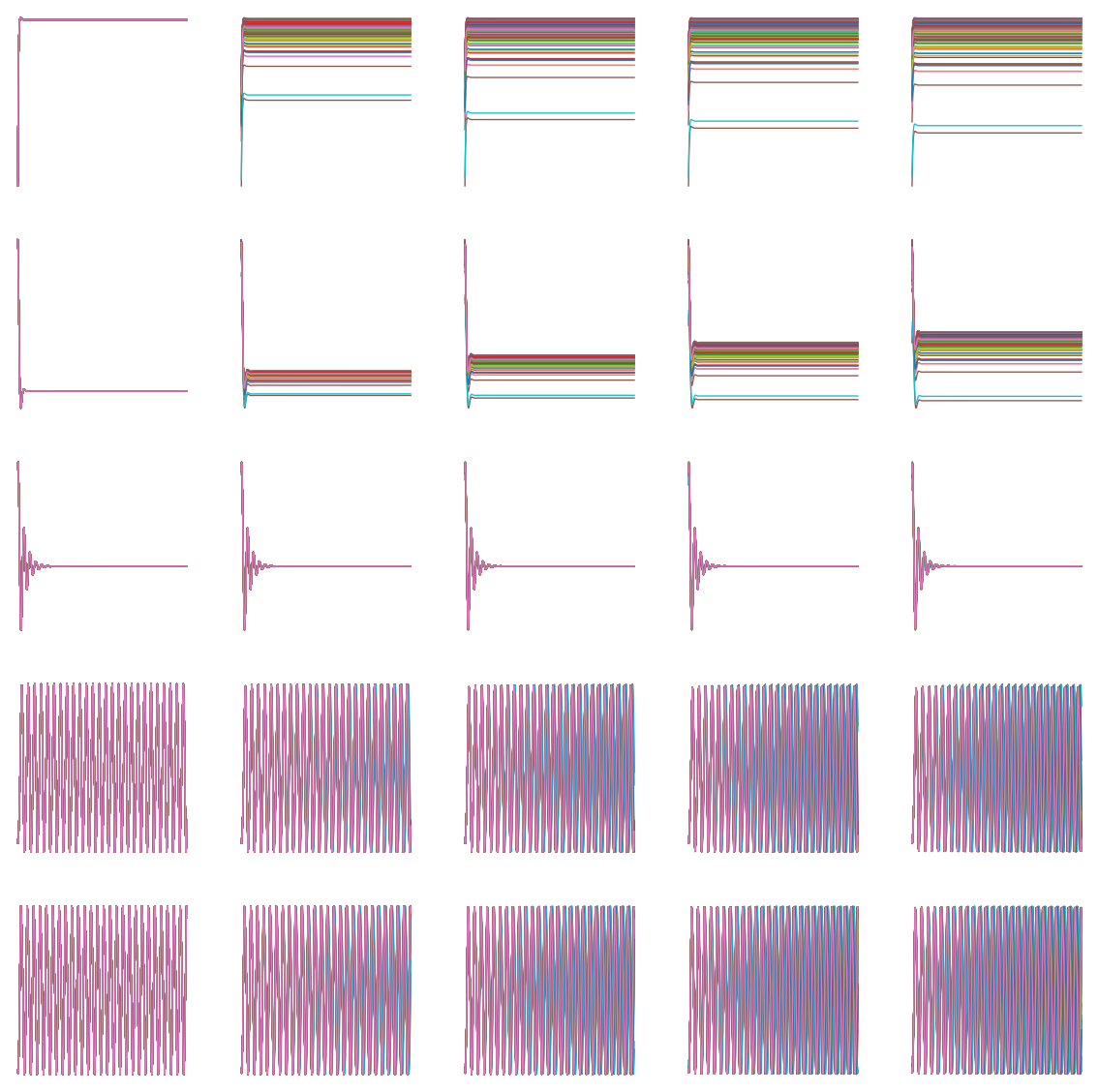
SimulationExperiment(dynamics=lorenz).run(duration=1000).integration.plot()
============================================================
STEP 1: Running simulation...
============================================================
  Simulation period: 1000.0 ms, dt: 0.01220703125 ms
  Transient period: 0.0 ms
  Simulation complete.

============================================================
Experiment complete.
============================================================
import matplotlib.pyplot as plt
from tvbo import Network
from tvbo import SimulationExperiment, Dynamics
from tvbo import Coupling
from tvboptim.types import GridAxis, Space
from tvboptim.execution import ParallelExecution
import jax
import bsplot

c = Coupling.from_ontology("Linear")
c.parameters["a"].value = 1.0

sc = Network.from_db("DesikanKilliany")
sc.add_transform("weight", "(W - W_min) / (W_max - W_min)")
sc.coupling["Linear"] = c

exp = SimulationExperiment(
    dynamics=Dynamics.from_ontology("Generic2dOscillator"),
    network=sc,
    integration={
        "method": "Heun",
        "duration": 3000,
        "step_size": 0.1,
    },
)

model = exp.execute("jax")

state = exp.collect_state()

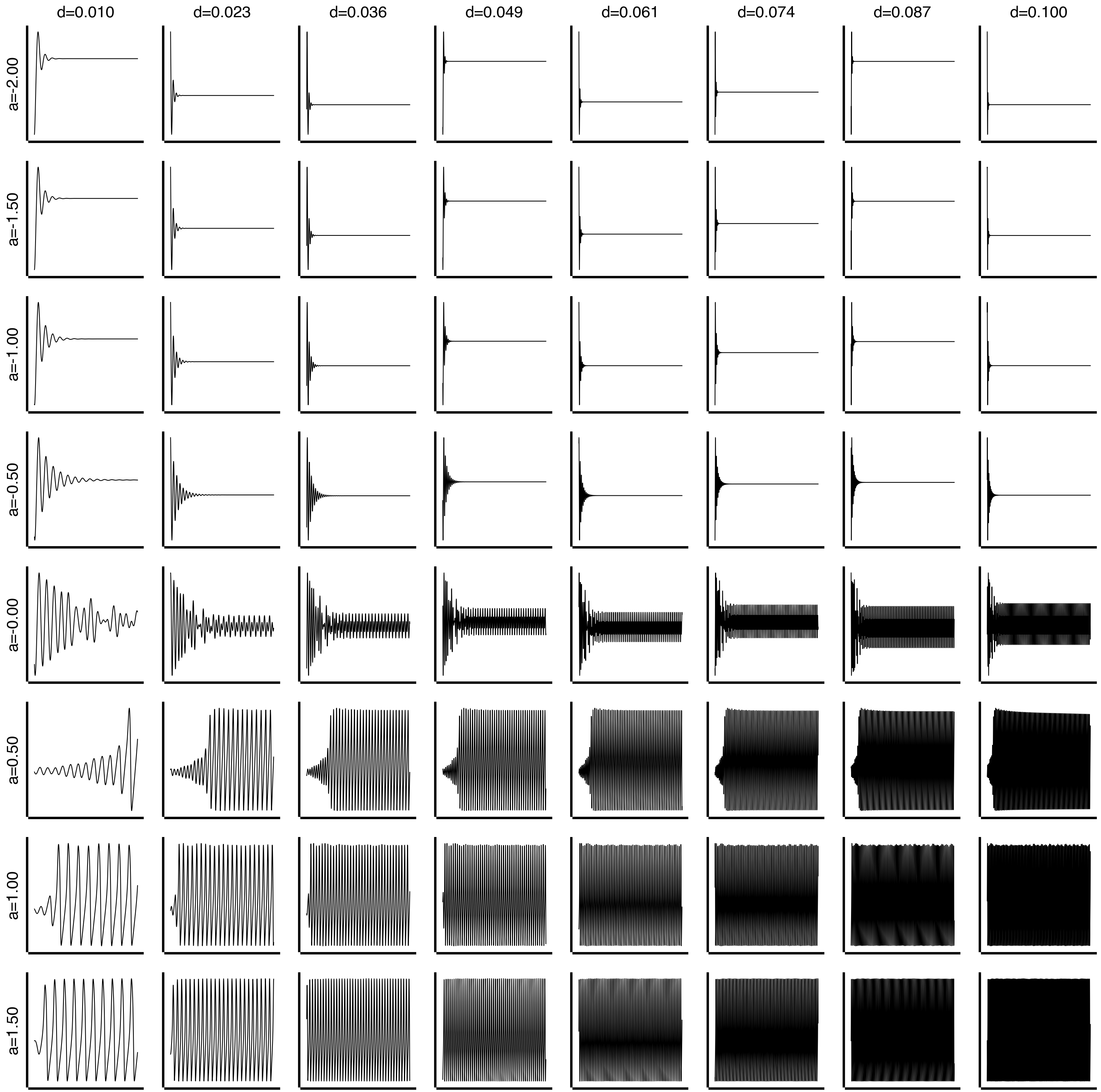
n = 8
# Explore a (controls Hopf bifurcation) and d (time scale separation)
# a ~ 0 is the bifurcation point; d controls fast/slow dynamics
state.parameters.dynamics.a = GridAxis(-2, 1.5, n)
state.parameters.dynamics.d = GridAxis(0.01, 0.1, n)
grid = Space(state, mode="product")

n_devices = jax.device_count()


def explore():
    exec = ParallelExecution(model, grid, n_pmap=n_devices, n_vmap=10)
    return exec.run()


exploration_results = explore()

print(exploration_results.results.shape)

# Reshape: (n_pmap, n_vmap, time, state_vars, nodes, modes) -> (n_combinations, time, state_vars, nodes)
data = exploration_results.results.data.squeeze()  # remove modes dim
# Flatten n_pmap and n_vmap dimensions
data = data.reshape(-1, *data.shape[2:])  # (n_pmap*n_vmap, time, state_vars, nodes)

# Get parameter values directly from the grid (no redundant linspace!)
axis_vals = grid._generate_axis_values()
a_vals = axis_vals.parameters.dynamics.a
d_vals = axis_vals.parameters.dynamics.d

fig, axs = plt.subplots(n, n, figsize=(12, 12))
for i in range(min(n * n, data.shape[0])):
    row, col = i // n, i % n
    ax = axs[row, col]
    # data[i] has shape (time, state_vars, nodes) - plot first state variable, first node
    ax.plot(data[i, 1000:, 0, 0], linewidth=0.5)

    # Labels: rows = a (first axis), cols = d (second axis)
    if row == 0:
        ax.set_title(f"d={d_vals[col]:.3f}", fontsize=10)
    if col == 0:
        ax.set_ylabel(f"a={a_vals[row]:.2f}", fontsize=10)

bsplot.style.format_fig(fig)

for ax in fig.axes:
    ax.set_xticks([])
    ax.set_yticks([])
(8, 8, 30000, 2, 87, 1)